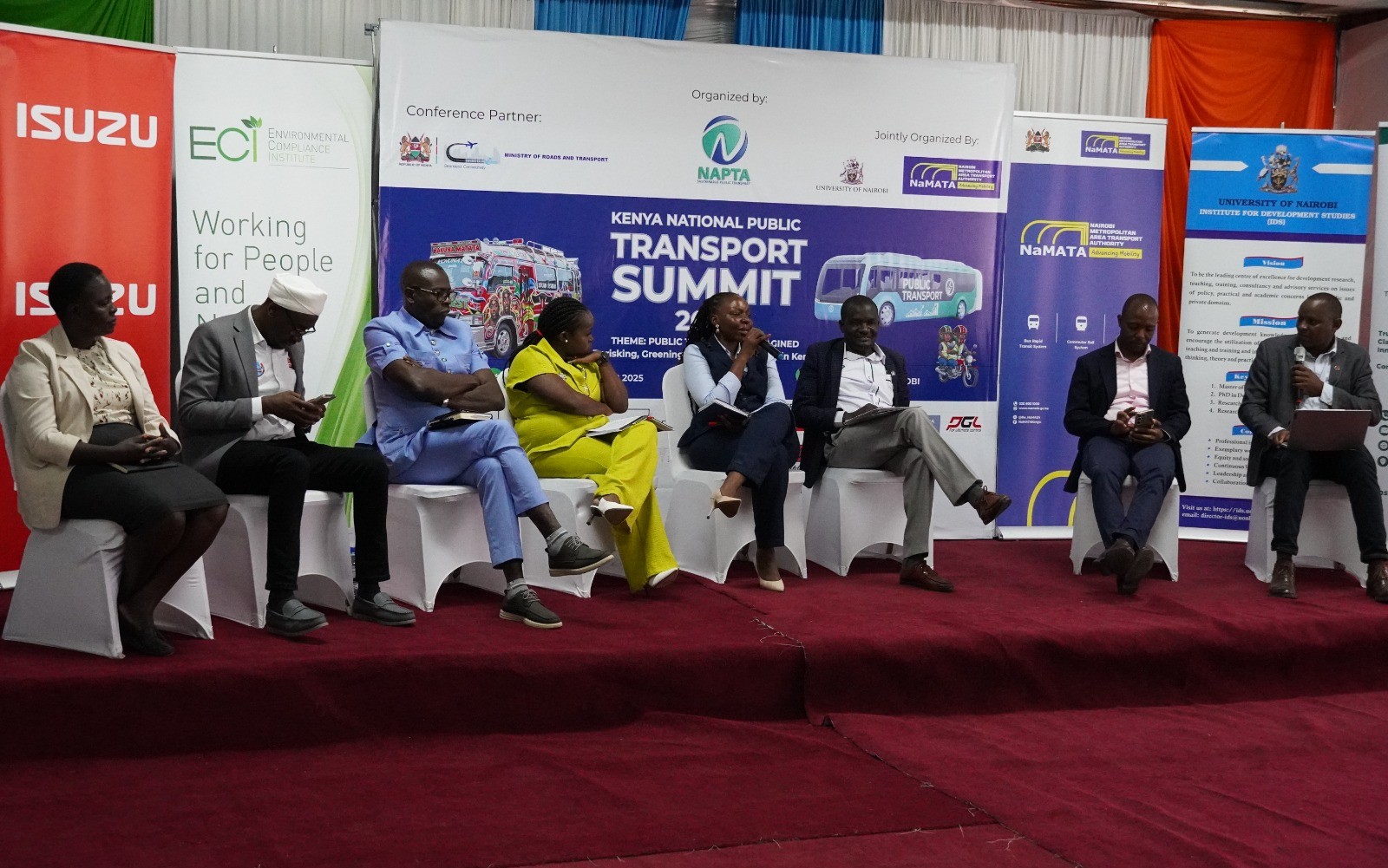
Kenya’s mobility landscape reached a significant turning point this week at the Kenya National Public Transport Summit (KNPTS), held at the University of Nairobi on 26th and 27th November. Convened by the National Alliance of Public Transport Advocates (NAPTA) in collaboration with the Institute for Development Studies (IDS) at the University of Nairobi, the summit served as a high-level convergence for stakeholders to transition from policy dialogue to decisive, transformative action.
The summit made one thing clear: Kenya has no shortage of policies or ideas, but what it urgently needs is decisive action that transforms commuters’ daily experiences. Under the theme ‘Public Transport Reimagined: De-risking, Greening and Dignifying Mobility in Kenya’, the two days of solution-focused dialogue centred on shifting from theoretical frameworks to implementation-ready projects that resolve the fragmented governance currently slowing progress.
As a Strategic Institutional Partner and Gold Sponsor, NaMATA moved beyond visionary discourse to provide the technical leadership necessary to move the sector towards practical, implementable solutions. Our teams provided significant technical contributions across six critical thematic areas, directly addressing the summit’s calls for action:
- Policy and Governance: Facilitating the technical harmonisation of regulatory frameworks to ensure seamless regional mobility and eliminate institutional silos.
- Digital Mobility Ecosystems: Sharing expertise in digital mapping and the technical readiness required for unified national payment standards and interoperable data protocols.
- Sustainable Transition: Advising on the technical requirements for large-scale e-mobility integration and the standardisation of high-performing green corridors.
- Infrastructure Delivery: Focusing on the technical quality assurance required to ensure high-capacity corridors meet real-world travel demands and operational efficiency.
- Inclusive Universal Access: Championing universal design standards to ensure that transit hubs and non-motorised transport (NMT) networks are safe and dignified for all citizens.
- Workforce Professionalisation: Advocating for industry-wide technical training and certification frameworks to elevate service standards and ensure the safety of the workforce.
The strength of the summit lay in its diversity of perspectives. It brought together a broad spectrum of stakeholders, including national and county policymakers, transport leaders, development partners, researchers, civil society, and public transport operators. Most importantly, the dialogue included the citizens who rely on these systems daily. Across these discussions, a recurring concern was the gap between strong policy frameworks and real impact on commuters’ lives. Technology emerged as a powerful catalyst; however, participants—including operators and researchers—warned that innovation must be coordinated within a unified digital mobility ecosystem built on shared standards and interoperability.
The summit also challenged long-held assumptions about who public transport serves. Gender, age, and care-responsive design took centre stage, revealing how “neutral” policies often overlook the distinct needs of women, children, older persons, and persons with disabilities. Climate action also featured prominently, with calls for accelerated green mobility through public–private partnerships and investment in electric transport solutions. Underlying all these ambitions is the public transport workforce; strengthening training and social protection for operators was recognised as fundamental to safety and system sustainability.
Beyond shaping these critical discussions, NaMATA was honoured with an accolade inscribed: “Presented to NaMATA in Recognition of Outstanding Leadership and Partnership towards KNPTS 2025”. This recognition of outstanding leadership in public transport transformation and exemplary partnership underscores NaMATA’s commitment to data-driven, people-centred approaches that are actively shaping the mobility future of the Nairobi Metropolitan Area. KNPTS did more than diagnose challenges; it signalled a shift towards integrated, people-centred transport reform.
